World Models are considered the holy grail for embodied AI and general intelligence. We study Joint Embedding Predictive Architectures (JEPA) and hierarchical world models to enable long-horizon planning in robotics, without relying on pixel-space reconstruction or hand-picked demonstrations.
Based at IIT Bombay, we are an open research group. We post weekly updates, paper discussions, and experiment logs here.
Blogs
Experiments on Hierarchy
NewWe try three ways to build a hierarchical world model for planning (token merging, a learnt latent encoder, and a pixel-space encoder) and diagnose why each one struggles on Push-T.
Breadth-First Search
Papers, blogs, podcasts consumed and ideas discussed around world models and planning.
Planning is terribly slow
We explore 3 ways to make planning faster: caching, faster trajectory search, and more conducive state spaces.
Research
Hierarchical JEPA for Long-Horizon Planning
Current world-model planners (DINO-WM, VJEPA2-AC) excel at short horizons but degrade sharply beyond a few seconds. For instance, a push-T task with a 16-second horizon drops from ~100% to 10% success. We propose adding a higher-level JEPA layer (JEPA-2) that reasons at coarser time scales and provides the goal representation used by the lower-level planner, enabling hierarchical, sample-efficient planning over long horizons.
Training is entirely self-supervised: JEPA-2 is trained on the intermediate states that JEPA-1 finds hardest to predict, so no additional labelled data is required. The latent-space formulation keeps compute tractable and makes the scheme scalable to more abstraction levels.
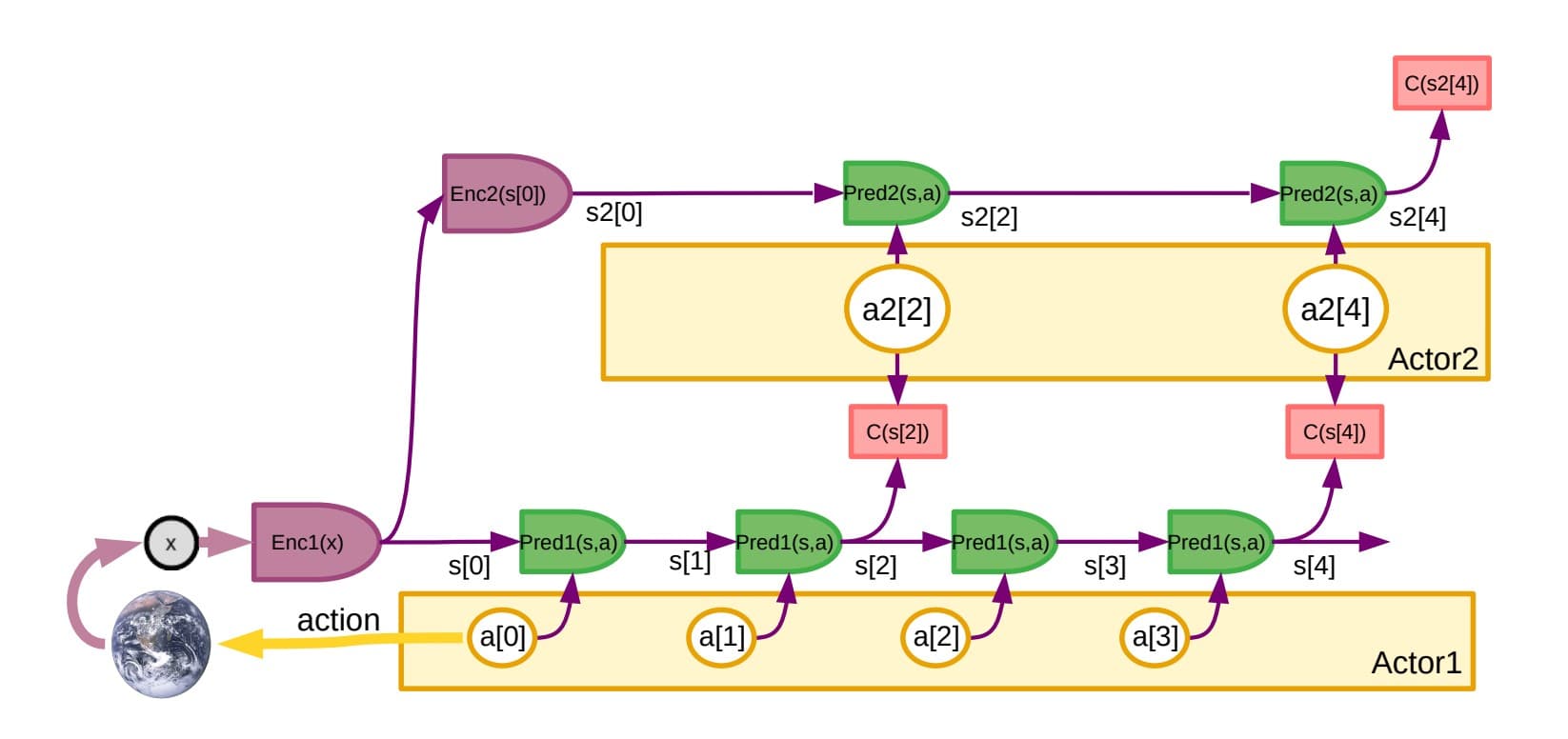
Fig 1. Hierarchical JEPA — from LeCun's 2022 position paper on autonomous machine intelligence.
01
Hierarchical planning layer on top of today's world-model planners, enabling Systems 2 thinking over long horizons.
02
Scalable, fully self-supervised training that requires significantly less compute than pixel-level methods.
03
Empirical verification that semantically rich JEPA features transfer to downstream robotics planning.

Fig 2. Push-T task — success drops from ~100% at short horizons to 10% at 16 s without hierarchical planning.
Reading List
LeJEPA: Heuristics-Free Training of JEPAs
arXiv 202502Provable Benefits of Latent-Space Reconstruction
arXiv 202503How JEPA Avoids Noisy Features
NeurIPS 202404LeWM: First Use of LeJEPA for World Models
arXiv 202605When Does LeJEPA Learn a World Model?
arXiv 202606Hierarchical World Models: Abstracting Time, Not State
arXiv 2026Connect
Interested in collaborating or joining? DM any one of us.